
Thread Unit Converter
The thickness of threads can be expressed using various different units of measurement and numbering systems. What they all have in common is that they represent the weight of a unit length of thread.
There are three types of thread units, including fixed-length systems, fixed-weight systems, and special standards.
- Fixed-length systems include Tex, dTex, and Denier;
- Fixed-weight systems include Ne and Nm;
- Other standard mainly refers to Ticket.
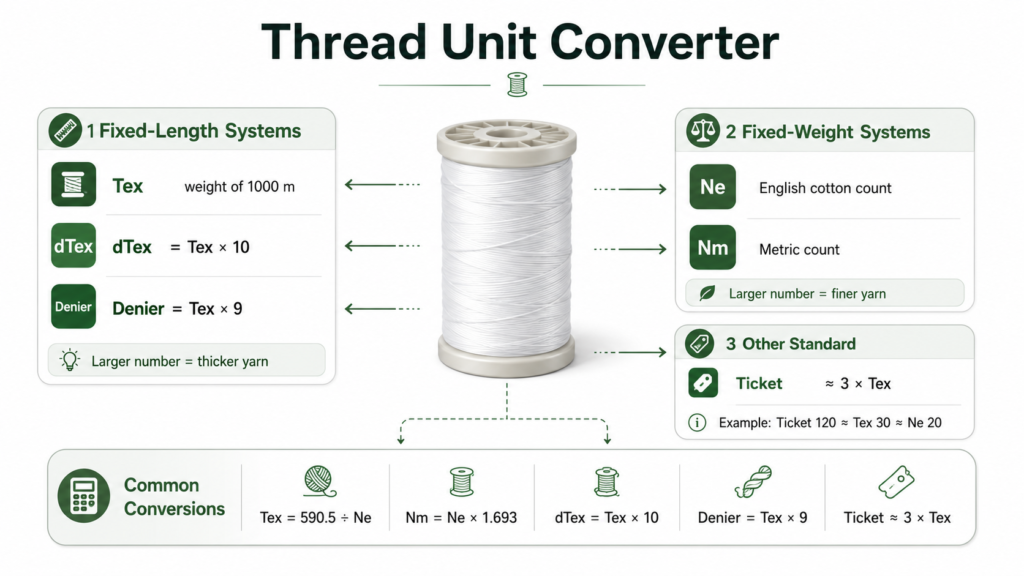
Fixed-Length System
Larger number = thicker yarn
Tex
Definition: Weight in grams of 1000 meters of yarn
Formula: Tex = Weight(g) ÷ Length(km)
Example: 1 Tex = 1 gram per 1000 meters
Applications: Universal standard for sewing threads
Decitex
Definition: Weight in grams of 10,000 meters of yarn
Formula: dTex = Tex × 10
Example: 1 dTex = 1 gram per 10,000 meters
Applications: European standard, finer measurements
- Characteristics: Larger number = thicker yarn
Denier
Definition: Weight in grams of 9000 meters of yarn
Formula: Denier = Tex × 9
Example: 1 Denier = 1 gram per 9000 meters
Applications: Synthetic filaments, hosiery, transparent threads
- Characteristics: Larger number = thicker yarn
Fixed-Weight System
Larger number = finer yarn
Ne (English Cotton Count)
Definition: Number of 840-yard hanks in 1 pound of yarn
Formula: Ne = Length(yd) ÷ [840 × Weight(lb)]
Example: Ne 1 = 840 yards per pound
Applications: Traditional cotton industry standard, global usage
Nm (Metric Count)
Definition: Number of meters in 1 gram of yarn
Formula: Nm = Length(m) ÷ Weight(g)
Example: Nm 1 = 1 meter per gram
Applications: European technical documentation, wool industry
Other Standard
Larger number = finer yarn
Ticket
Definition: Special numbering system for sewing threads
Characteristics: Ticket ≈ 3 × Tex
Standard: Ticket 120 ≈ Tex 30 ≈ Ne 20
Yarn Structure Notation
Single yarn: Ne 40 (single strand of 40-count yarn)
Plied yarn: Ne 40/2 (2 strands of Ne 40 yarn twisted together)
Plied count: Total count = Single count ÷ Number of plies
Example: Ne 40/2 ≈ Ne 20 (after plying)
Most Commonly Used Convertion Formulas
- Ne → Tex: Tex = 590.5 ÷ Ne
- Ne → Nm: Nm = Ne × 1.693
- Tex → Decitex: dTex = Tex × 10
Tex → Denier: Denier = Tex × 9
- Tex → Ticket: Ticket = 3 × Tex (approximate)
Ticket → Ne: Ne = Ticket ÷ 6 (approximate)